Barbara Hammer
Barbara Hammer
Biography
With a career spanning fifty years, Barbara Hammer is recognized as a pioneer of queer cinema. Working primarily in film and video, Hammer created a groundbreaking body of experimental work that illuminates lesbian histories, women’s health and aging, and global political struggles. Guided by her urgent need to document communities rarely represented in mainstream cinema, she asserted that “radical content deserves radical form.” Using documentary and found footage, her works are characterized by her robust experimentation with montage, superimposition, and overexposure.
Hammer’s 8mm and 16mm films of the 1970s have been recognized as some of the first major representations of lesbian sexuality made from a lesbian point of view. Her landmark film, Dyketactics (1974), evinces a distinctly queer and formally inventive approach to representing lesbian desire. A roving handheld camera captures sensual encounters among a group of women in a forest, their entangled bodies merging into singular forms and abstractions. Hammer’s intent to create a “new cinema” melding sight and touch was furthered realized in Sync Touch (1981). The film undercuts scientific analyses of touch by presenting close-ups of a woman’s body, privileging the intimacy of embodied experience over the more detached domain of scientific knowledge.
Hammer also made significant contributions to the early history of video art that foreground the immediacy and confessional nature of the medium. In Superdyke Meets Madame X (1975), her first use of the Portapak, Hammer records her intimate encounters and conversations with media artist and collaborator Max Almy, while they simultaneously observe how the presence of the camera mediates their interactions.
Nitrate Kisses (1992) was Hammer’s first feature-length documentary film. Structured as a three-part essay film, it interrogates the invisibility of homosexuality in collective historical memory and official records. Drawing from archival materials and found footage, Hammer recovers gay and lesbian stories, bringing them into dialogue with present-day testimonies of gay and lesbian couples.
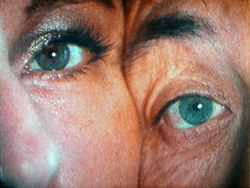
Throughout her career, Hammer also explored issues of public health, death, and the aging body. Snow Job: The Media Hysteria of AIDS (1985) presents a cascading montage of headlines exposing the media’s inflammatory reporting on the disease. Optic Nerve (1985) makes tactile connections between the fragility of film and of aging bodies, employing optical printing and layered footage of her grandmother in a nursing home. A Horse Is Not a Metaphor (2008) responds to Hammer’s 2006 diagnosis with Stage 3 ovarian cancer. Presenting herself not merely as surviving, but thriving, the autobiographical film features images of the artist undergoing treatment and culminates in shots of the artist riding horses in expansive landscapes across the American West.
Evidentiary Bodies (2018), Hammer’s multi-channel video installation, showcases her enduring interest in the empathetic and tactile possibilities of the moving image. Personal photographs and imagery from previous works, including Sanctus (1990) and Chest X-rays (2015), were projected onto the gallery walls and, in turn, gallery viewers, making porous the boundaries between the artist and the audience. First developed as a multidisciplinary project and performance at Microscope Gallery in 2016, the installation has since been exhibited at The Wexner Center for the Arts in 2019 and The Fralin Museum of Art in 2024 and was acquired by the Whitney Museum of American Art in 2024.
Hammer’s work has been screened at festivals and exhibitions around the world, including Sisters!, La Virreina Centre de la Imatge, Barcelona (2020); Barbara Hammer: Boundless, National Gallery of Art, Washington DC (2019); Evidentiary Bodies, Leslie-Lohman Museum of Art (2017); Jeu de Paume, Paris (2012); Museum of Modern Art, New York (2010); Tate Modern Museum, London England (2012); Kunsthall, Oslo, Norway (2013); Toronto Film Festival (2013); and Pink Life Queer Festival, Ankara and Istanbul, Turkey. Solo exhibitions of her work have also been held at Champ Lacombe, London; Company Gallery, New York; Wexner Center for the Arts, Columbus, OH (2019). Hammer’s work was also included in the 1985, 1989, 1993, and 2019 Whitney Biennials.
Hammer received her B.A. in Psychology from UCLA in 1961, followed by an M.A. in English Literature in 1963 and M.A. in Film in 1975, both from San Francisco State University. In 1997, she completed post-masters studies in Multi-Media Digital Studies at the American Film Institute, Los Angeles. Hammer was born in 1939 in Hollywood, California. She lived and worked in New York until her death in 2019.

