Description
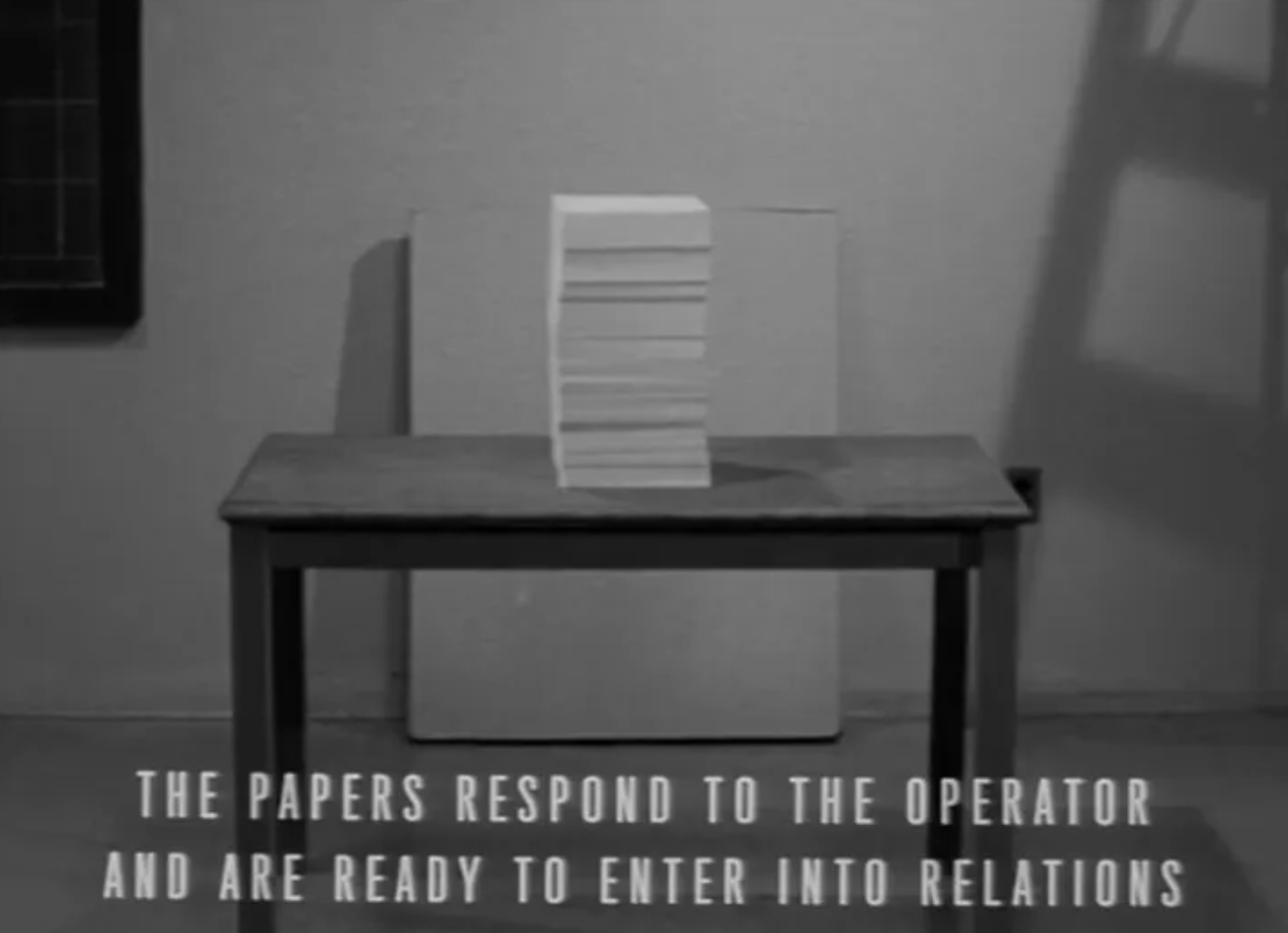
Beloff’s three-channel film incorporates staged reenactments and two archival films—Motion Studies Application and Folie a Deux—both industrial productions from the early 1950’s. Motion Studies teaches workers to maximize their efficiency through small movements, and Folie a Deux demonstrates how to identify the titular psychiatric disorder. Together, the films present the extremes of the productive and unproductive body and study their respective choreographies. A third sequence, inspired by slapstick productions, sets the two previous films into dialectical motion by depicting an office setting wherein objects take on a life of their own. As the materials mysteriously float, spin, and spill over, they disrupt the order of capitalist productivity.
Writes Beloff: “Slapstick posits a new relationship between the world of things and the world of people. It begins by destroying the order of the world that we know. And leads us where? We don’t know but that, I think, is its strength. It doesn’t proscribe for us but says quite simply that our world can be other than it is.”

