Search Results
Search Results
Title Results
Your search returned 886 Titles
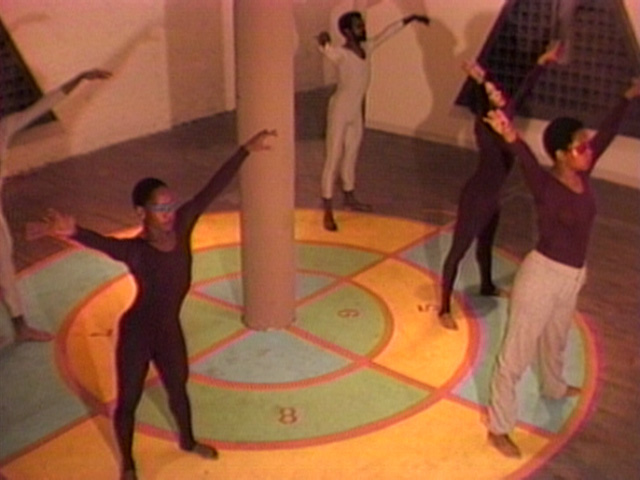
This video documents Cake Walk, an installation and performance piece by artist Houston Conwill, staged in November 1983 at Linda Goode Bryant's pioneering gallery Just Above Midtown (JAM), at its second (downtown) location on Franklin Street. The piece refers to the cakewalk dance which...
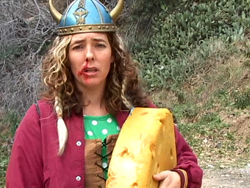
Roberta Smith writes in The New York Times, "Ms. Kahn is seen with a bloodied nose, a viking helmet and a large wedge of rubber Swiss cheese, rambling around Los Angeles, talking to the camera, Ms. Dodge and us. The one-sided conversation turns variously competitive ('You should have been there...
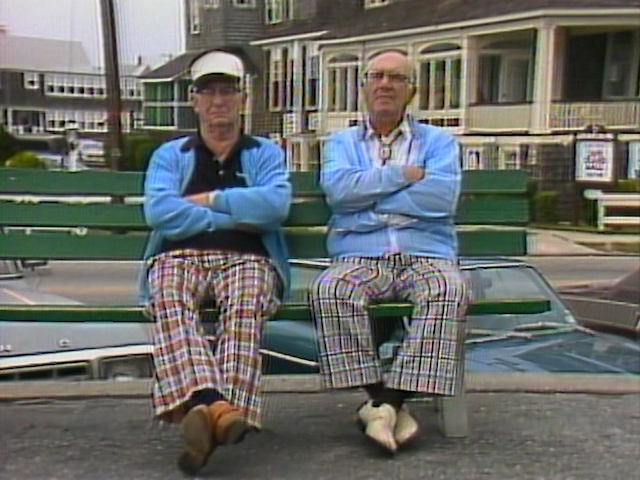
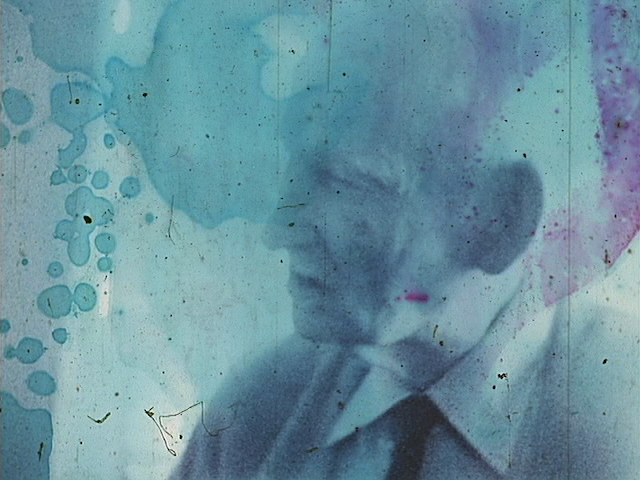
Carl Ruggles Christmas Breakfast 1963
Carolee Schneemann
2007, 9:02 min, color, sound, 16 mm film on video
In her earliest film, which has been newly transferred to video, Schneemann presents an abstracted portrait of the American composer Carl Ruggles, known for his irascible personality and finely-crafted atonal music. Ruggles is seen enjoying pie a la mode and ruminating on subjects ranging from Christmas to his incomplete opera The Sunken Bell. The hand-painted film stock heightens the impressionistic vitality of this snapshot of the 84-year-old composer.
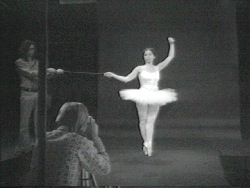
A photographic session in which the artist as "ballerina" is photographed by the "photographer" in a set of stills intended to represent her in the appropriately glamorous and correct positions, after only three months of ballet training. The tape juxtaposes the truth of the "still" image, adequate for 1/125 of a second, against the video camera's more extensive duration. The cropped reality photographed is compared to the "truth" of the video camera.
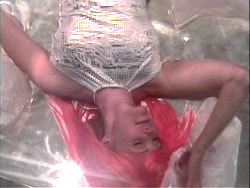
Juxtaposing two restagings of a melodramatic scene from The Who's rock opera Tommy, Donegan analyzes how media cannibalizes, revises, and resurrects itself. In Donegan's almost psychedelic renditions, a silver-garbed, red-wigged performer capers in a theatrical non-space of foil, plastic, police tape, and rescanned video images of Ann-Margret. First actress Garland Hunter enacts the scene, and then, in a silent version, Donegan herself takes the role.
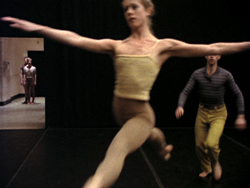
Channels/Inserts
Charles Atlas, Merce Cunningham
1982, 31:40 min, color, sound, 16 mm film on HD video
To create Channels/Inserts, Cunningham and Atlas divided the Cunningham Dance Company's Westbeth studio into sixteen possible areas for dancing and used chance methods based on the I Ching to determine the order in which these spaces would be used, the number of dancers to be seen, and the events that would occur in each space. Atlas employed cross-cutting and animated mattes or wipes to indicate a simultaneity of dance events occurring in different spaces, as well as to allow for diversity in the continuity of the image.
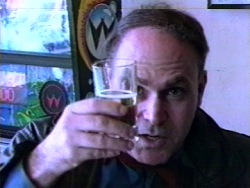
"I've got to stop drinking — less." — Stuart Sherman