Description
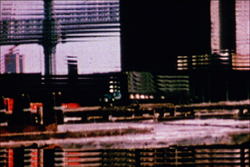
One of Ken Jacobs’ seminal works, The Sky Socialist is a rumination of a post-Holocaust world. Shot largely on the rooftop of Jacobs’apartment building in a pre-gentrified Lower Manhattan, The Sky Socialist stars Ken’s wife Flo as Anne Frank and Dave Leveson as the Russian émigré author Isadore Lhevine, as if to suggest this haven by the Brooklyn Bridge was a fleeting utopia in the midst of the destructive political and cultural upheaval of the 20th century. Ken continuously reedited and dabbled with The Sky Socialist from the mid-60s until its final completion in 2019, sporadically screening segments of the film of intermittent durations over the decades, with The Sky Socialist Stratified being released 45 years into the film’s gestation. Using digital tools to expand upon the original elements of the film, Jacobs converts The Sky Socialist Stratified into an analytical work akin to Tom, Tom the Piper’s Son (1969), dissecting and slicing his original source material to magnify its textural components, amplified by the dissonant classical soundtrack.
Writes Jacobs: “A digital visit in 2009 to where we, Flo and I, were in 1964/65. Young people, thereʼs no exaggerating how vivid, of the moment, whizbang and splendidly new 1964 and 65 were in their time, take my word. True, I was entering my thirties but Flo, my child-bride, was not yet 23. Underground Cinema had gotten momentarily hot just as my 16mm camera was stolen. I recoiled from the throng pushing to enter the circle of cheap celebrity and switched to 8mm. (“regular” was all there was). I then filmed The Sky Socialist, a sunny feature during the time of US assault upon the Vietnamese—Why? Because they were there—and afterwards struggled to make a decent 16mm blow-up, yet to happen. The duty of cinema as I understood it then was to lie, in order to make history bearable. The lie, however, was to be obvious enough so as to allude to the truth; film was a lie that invited seeing through, it was like religion but with a more of a wink. Flo then became a stand-in for Anne Frank, [Julie Motz as] The Muse Of Cinema flew to the rescue with a happy ending mostly because she knew doing so gave her a chance to look good. Our days were permeated with the transcendent music of Olivier Messiaen and Charles Ives and Arnold Schoenberg and so, naturally, was this perfectly self-indulgent film. For this visit some of Messiaen can still be heard, contending with the supremely hip sensibility of Michael Schumacher.”
WARNING: This work contains throbbing light. Should not be viewed by individuals with epilepsy or seizure disorders.
Filmed on standard 8mm, 1964-65.

